
Build a life that works for your brain
Neurodivergent-affirming occupational therapy for autistic, ADHD, and AuDHD teens and adults in Los Angeles — including those navigating co-occurring conditions.
It's the part of mental health care that helps you do the things, not just understand them.
I see clients in-person in West Los Angeles and online throughout California.
My practice operates in affiliation with Convergent Minds.

HOW I WORK
Care built around how your brain works
I'm Melanie Inouye, a Doctor of Occupational Therapy (OTD, OTR/L) specializing in neurodivergent-affirming mental health care.
This is the hands-on, practical side of mental health. The aim is to help you explore how your brain, nervous system, habits, environment, relationships, demands, and energy all interact, then translate that understanding into strategies that make daily life feel steadier and more sustainable.
Together, we identify what's creating friction in your life and develop individualized approaches that work with your brain rather than against it, building the systems, routines, environments, relationships, and skills that support the life you want to live.
Mental health occupational therapy bridges the gap between knowing and doing.
”
What Clients Say


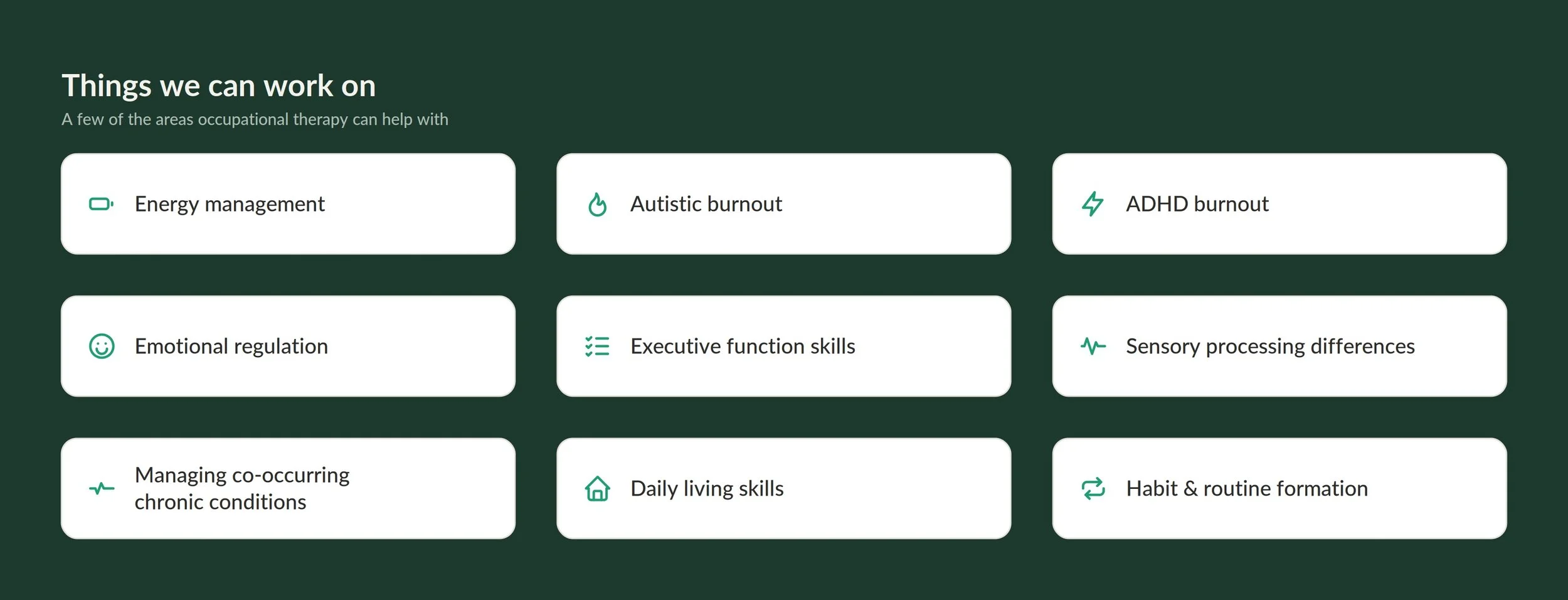
I offer in-person services in West Los Angeles and telehealth to clients located anywhere in California. Common areas I support virtually:
Where I work
Frequently Asked Questions
-
It's probably a good fit if any of these
sound familiar:
You're bright and capable, but school or work still feels like a constant struggle
You were diagnosed later in life, and you're still making sense of how your brain works
You're exhausted/burnt out in a way that sleep doesn't fix
You're navigating chronic health conditions alongside neurodivergence, and you need
support that understands how the two work together
You know what you need to do, but starting it feels almost impossible
Overwhelm comes on fast, and bringing yourself back down is hard
You used to be able to handle it all, and now you can't, and you don't know why
Everyday tasks like cooking, cleaning, and errands feel harder to stay on top of than they should
You can do the work itself, but planning, organizing, and meeting deadlines is where things fall apart
If you saw yourself in that list, occupational therapy will likely help.
The best way to know for sure is to book a free 15-minute consult, so we can talk it through together and figure out if it's the right fit.
-
No. I'm a private-pay, out-of-network provider, so I don't bill insurance directly.
I can give you a superbill, which is an itemized receipt you can submit to your insurance company for possible out-of-network reimbursement, depending on your plan.
-
Yes. Alongside clinical care, I offer non-clinical services that support community integration and daily living skills, and these can be paid for through self-determination funding.
-
It starts with a free 15-minute consultation, a call to talk through your current challenges and what you're interested in working on.
From there, we figure out the best next steps together.
-
No, a formal diagnosis is not required. If you relate to traits of neurodivergence but haven't been formally diagnosed, that's completely okay.
We work with what you're actually experiencing day-to-day, not a label on paper.
-
In short, I always say psychotherapy is about the processing, and occupational therapy is about the doing.
Both matter, and they work well together.
Talk therapy helps you unpack emotions, and occupational therapy helps you turn that understanding into routines, systems, and skills you can use in daily life.